Foraging spot
Common fig tree
Breba crop early summer, main crop late summer. Ripe = soft and drooping.
Coordinates: 37.858658, -122.292336
Walk here → More about Common fig
What to do with it
- Eat fresh, warm off the tree
- Roast with honey
- Dry for later; bake into tarts
Ways to keep it
- Fig jam
- Fig vinegar
- Lacto-ferment whole
- Dry the figs
About Common fig
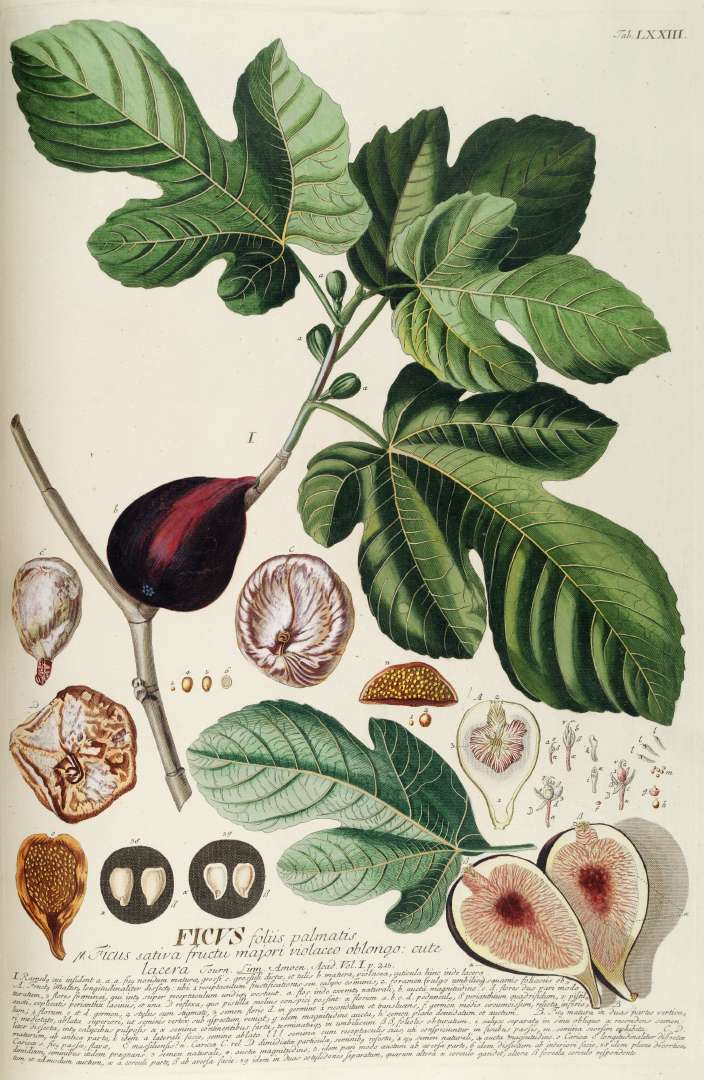
The fig is the edible fruit of Ficus carica (the common fig), a species of tree or shrub in the flowering plant family Moraceae, native to the Mediterranean region, and to western and southern Asia. It has been cultivated since ancient times and is now widely grown throughout the world. Ficus carica is the type species of the genus Ficus, which comprises over 800 tropical and subtropical plant species. The fig plant is a deciduous tree or large shrub, growing up to 7–10 m (23–33 ft) tall, with smooth white bark. Its large leaves have three to five deep lobes. Its fruit (a syconium) is teardrop-shaped, 3–5 cm (1–2 in) long, initially green but may ripen toward purple or brown, and has sweet soft reddish flesh containing numerous small seeds. In the Northern Hemisphere, fresh figs are in season from early August to early October. They tolerate moderate seasonal drought and can be grown even in hot-summer continental climates. In 2020, world production of raw figs was 1.26 million tonnes, led by Turkey (with 25% of the world total), Egypt, Morocco, and Algeria, collectively accounting for 62% of the total. Although the milky sap of the green parts of the plant is an irritant to human skin, figs can be eaten fresh or dried. They are also processed into jam, rolls, biscuits, and other types of desserts. Since ripe fresh figs are easily damaged in transport and do not keep well, most commercial production is in dried and processed forms. Raw figs contain roughly 80% water and 20% carbohydrates, with negligible protein, fat, and micronutrient content. They are a moderate source of dietary fiber.
From Wikipedia.
Tree and plant locations come from Falling Fruit, a volunteer-run map of the urban harvest, used under CC BY-NC-SA 4.0. This project is non-commercial. Locations are crowd-sourced and provided as-is — always confirm a plant's identity and that you're welcome to pick before foraging.
Photos and descriptions from Wikipedia / Wikimedia Commons. Maps © OpenStreetMap contributors. Not affiliated with Falling Fruit, Wikimedia, or OpenStreetMap.