green
Foraging Wild mustard
Peppery greens and bright flowers in the cool months; collect seeds to make mustard.
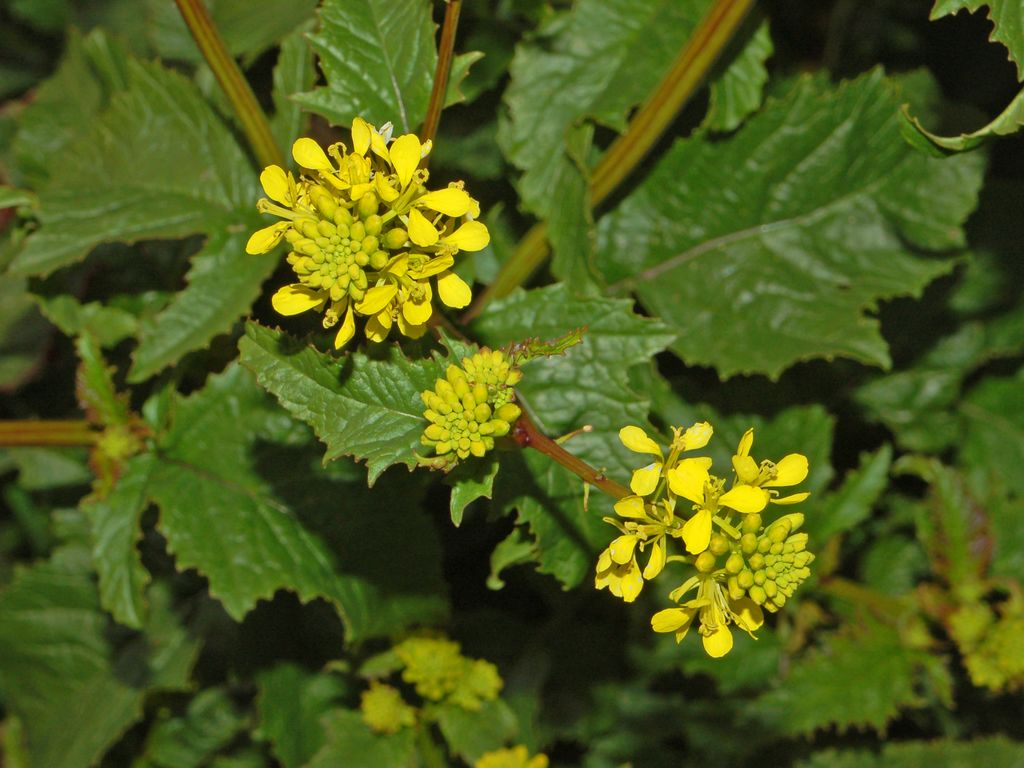
What to do with it
- Sauté the greens like kale
- Toss the flowers into salad
- Grind the seeds into mustard
Ways to keep it
- Whole-grain mustard from the seeds (ferment)
- Lacto-ferment the greens
- Pickle the flower buds (vinegar)
About Wild mustard
Brassicaceae () or (the older but equally valid) Cruciferae () is a medium-sized and economically important family of flowering plants commonly known as the mustards, the crucifers, or the cabbage family. Most are herbaceous plants, while some are shrubs. The leaves are simple (although are sometimes deeply incised), lack stipules, and appear alternately on stems or in rosettes. The inflorescences are terminal and lack bracts. The flowers have four free sepals, four free alternating petals, two shorter free stamens and four longer free stamens. The fruit has seeds in rows, divided by a thin wall (or septum). As of 2023, the family was divided into two subfamilies, Brassicoideae and Aethionemoideae, and as of September 2025, it contained over 350 accepted genera. The family contains the cruciferous vegetables, including species such as Brassica oleracea (cultivated as cabbage, kale, cauliflower, broccoli and collards), Brassica rapa (turnip, Chinese cabbage, etc.), Brassica napus (rapeseed, etc.), Raphanus sativus (common radish), Armoracia rusticana (horseradish), the cut-flower Matthiola (stock) and the model organism Arabidopsis thaliana (thale cress). Pieris rapae and other butterflies of the family Pieridae are some of the best-known pests of Brassicaceae species planted as commercial crops. Trichoplusia ni (cabbage looper) moth is also becoming increasingly problematic for crucifers due to its resistance to commonly used pest control methods. Some rarer Pieris butterflies, such as P. virginiensis, depend upon native mustards for their survival in their native habitats. Some non-native mustards such as Alliaria petiolata (garlic mustard), an extremely invasive species in the United States, can be toxic to their larvae.
From Wikipedia.
Tree and plant locations come from Falling Fruit, a volunteer-run map of the urban harvest, used under CC BY-NC-SA 4.0. This project is non-commercial. Locations are crowd-sourced and provided as-is — always confirm a plant's identity and that you're welcome to pick before foraging.
Photos and descriptions from Wikipedia / Wikimedia Commons. Maps © OpenStreetMap contributors. Not affiliated with Falling Fruit, Wikimedia, or OpenStreetMap.