green
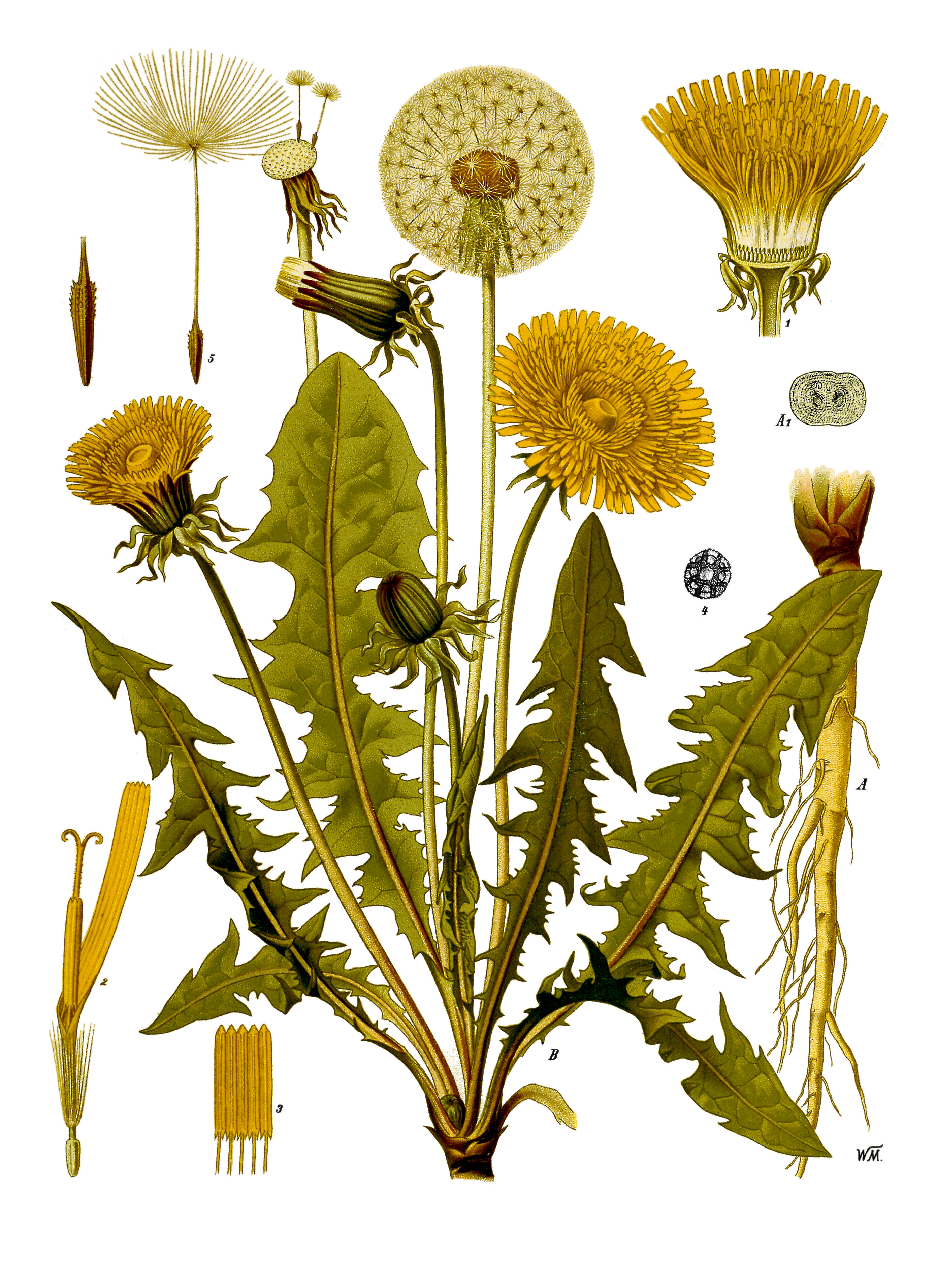
Foraging Dandelion
The whole plant is edible. Young leaves are least bitter; flowers fry up, roots roast like chicory.
What to do with it
- Young leaves raw or sautéed
- Batter & fry the flowers
- Roast the root as a coffee substitute
Ways to keep it
- Dandelion-flower 'wine' (ferment)
- Dandelion-flower syrup
- Lacto-ferment the greens
- Dry the roots
About Dandelion
Taraxacum () is a genus of flowering plants in the family Asteraceae which consists of species commonly known as dandelions. The scientific and hobby study of the genus is known as taraxacology. The genus has a near-cosmopolitan distribution, absent only from tropical and polar areas. Two of the most common species worldwide, T. officinale (the common dandelion) and T. erythrospermum (the red-seeded dandelion), are European species introduced into North America, where they are non native. Dandelions thrive in temperate regions and can be found in yards, gardens, sides of roads, among crops, and in many other habitats. Like other members of the family Asteraceae, they have very small flowers collected together into a composite flower head. Each single flower in a head is called a floret. In part due to their abundance, along with being a generalist species, dandelions are one of the most vital early spring nectar sources for a wide host of pollinators. Many Taraxacum species produce seeds asexually by apomixis, where the seeds are produced without pollination, resulting in offspring that are genetically identical to the parent plant.
From Wikipedia.
Tree and plant locations come from Falling Fruit, a volunteer-run map of the urban harvest, used under CC BY-NC-SA 4.0. This project is non-commercial. Locations are crowd-sourced and provided as-is — always confirm a plant's identity and that you're welcome to pick before foraging.
Photos and descriptions from Wikipedia / Wikimedia Commons. Maps © OpenStreetMap contributors. Not affiliated with Falling Fruit, Wikimedia, or OpenStreetMap.