fruit
Foraging Carob
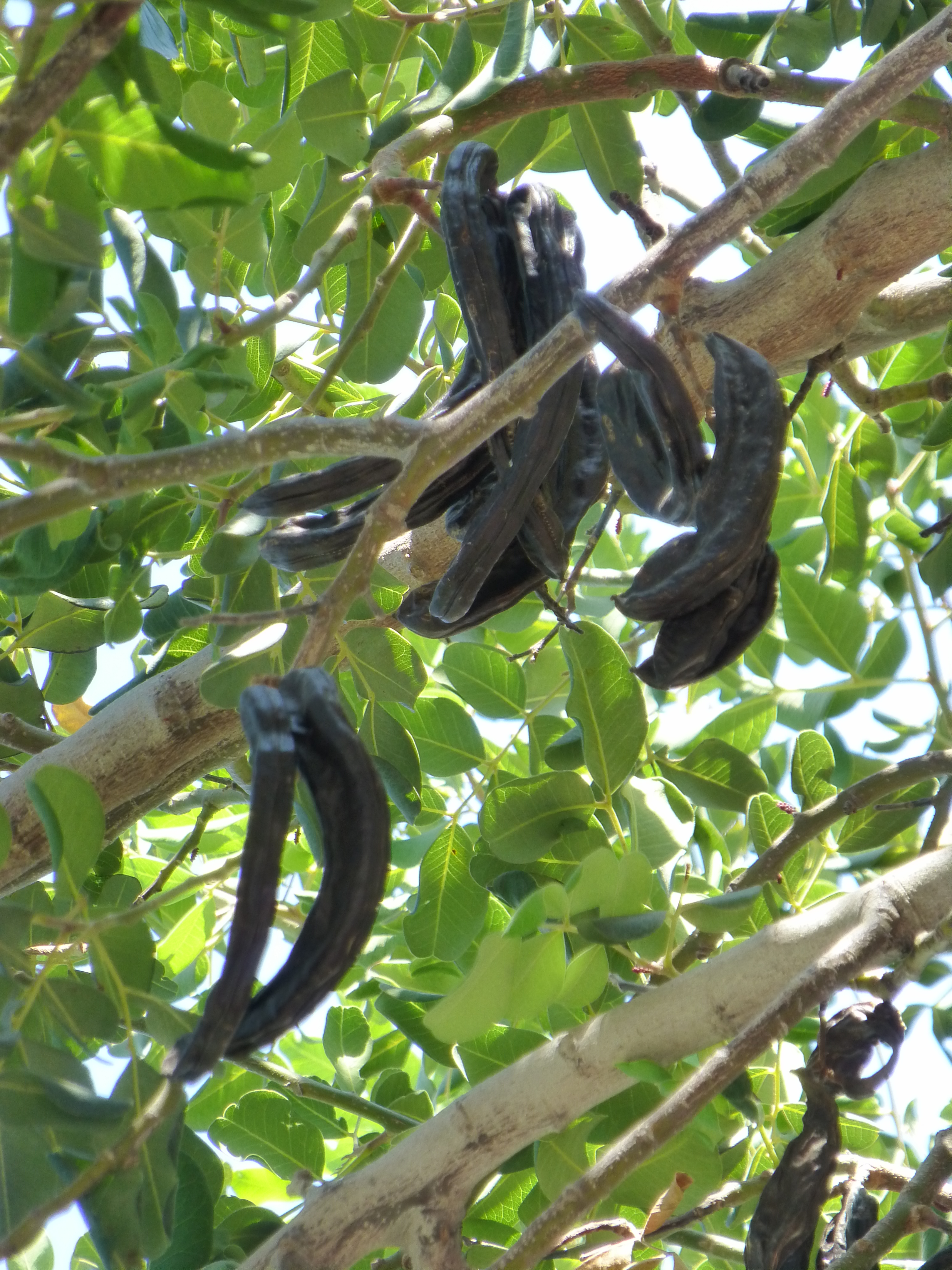
Long leathery brown pods on a common street tree. Sweet, roasted-malt flavor — a caffeine-free cocoa substitute. Roast and grind the pods (not the hard seeds).
What to do with it
- Roast & grind the pods into carob powder
- Snack on the sweet dried pods
- Simmer into a syrup
Ways to keep it
- Dry & store the pods
- Carob powder keeps for months
- Carob syrup
About Carob
The carob ( KARR-əb; Ceratonia siliqua) is a flowering evergreen tree or shrub in the Caesalpinioideae subfamily of the legume family, Fabaceae. The carob tree is native to the Mediterranean region and the Middle East. It is widely cultivated for its edible fruit, which takes the form of seed pods, and as an ornamental tree in gardens and landscapes. Spain is its largest producer, followed by Italy and Morocco. Carob pods have a number of culinary applications, including a powder or chips that can be used as a chocolate alternative. The seeds are used to produce locust bean gum or carob gum, a common thickening agent used in food processing.
From Wikipedia.
Tree and plant locations come from Falling Fruit, a volunteer-run map of the urban harvest, used under CC BY-NC-SA 4.0. This project is non-commercial. Locations are crowd-sourced and provided as-is — always confirm a plant's identity and that you're welcome to pick before foraging.
Photos and descriptions from Wikipedia / Wikimedia Commons. Maps © OpenStreetMap contributors. Not affiliated with Falling Fruit, Wikimedia, or OpenStreetMap.