herb
Foraging California bay
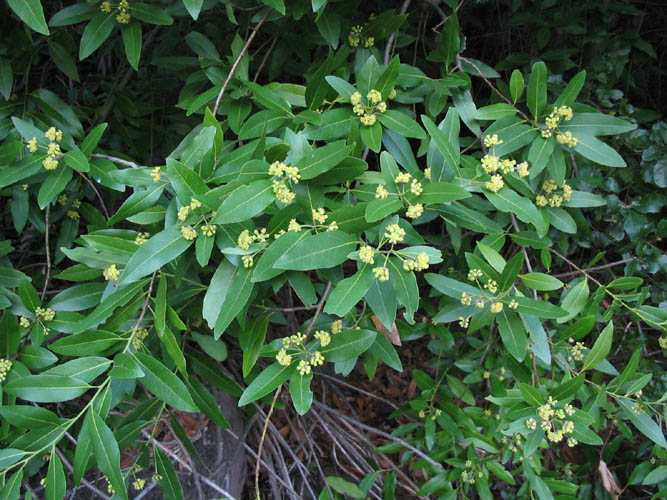
California bay / pepperwood (Umbellularia). One leaf does the work of two regular bay leaves — potent. 'Bay nuts' ripen in fall.
What to do with it
- Use a leaf (half a regular bay) in soups & braises
- Roast the 'bay nuts' — taste of bitter chocolate-coffee
- Infuse into broth or oil
Ways to keep it
- Dry the leaves for the spice rack
- Roast & store the bay nuts
- Bay-infused oil or vinegar
About California bay
Umbellularia californica is a large hardwood tree native to coastal forests and the Sierra foothills of California, and extending into the coastal forests southwestern Oregon and the mountains of northwestern Baja California. It is the sole species in the genus Umbellularia, in the laurel family Lauraceae. The tree's pungent leaves have a similar flavor to bay leaves, though stronger, and it may be mistaken for bay laurel. In Yuki, it is called pōl'-cum ōl. In Oregon, this tree is known as Oregon myrtle, while in California it is called California bay laurel, which may be shortened to California bay or California laurel. It has also been called pepperwood, spicebush, cinnamon bush, peppernut tree, headache tree, mountain laurel, and balm of heaven. The tree is endemic to the California Floristic Province. It is a host of the pathogen that causes sudden oak death. The dry wood has a color range from blonde (like maple) to brown (like walnut). It is considered an excellent tonewood and is sought after by luthiers and woodworkers. The species was first described as Tetranthera californica by William Jackson Hooker and George Arnott Walker Arnott in 1833. In 1842 Thomas Nuttall placed the species in the newly-described genus Umbellularia as U. californica.
From Wikipedia.
Find California bay near you →
Tree and plant locations come from Falling Fruit, a volunteer-run map of the urban harvest, used under CC BY-NC-SA 4.0. This project is non-commercial. Locations are crowd-sourced and provided as-is — always confirm a plant's identity and that you're welcome to pick before foraging.
Photos and descriptions from Wikipedia / Wikimedia Commons. Maps © OpenStreetMap contributors. Not affiliated with Falling Fruit, Wikimedia, or OpenStreetMap.